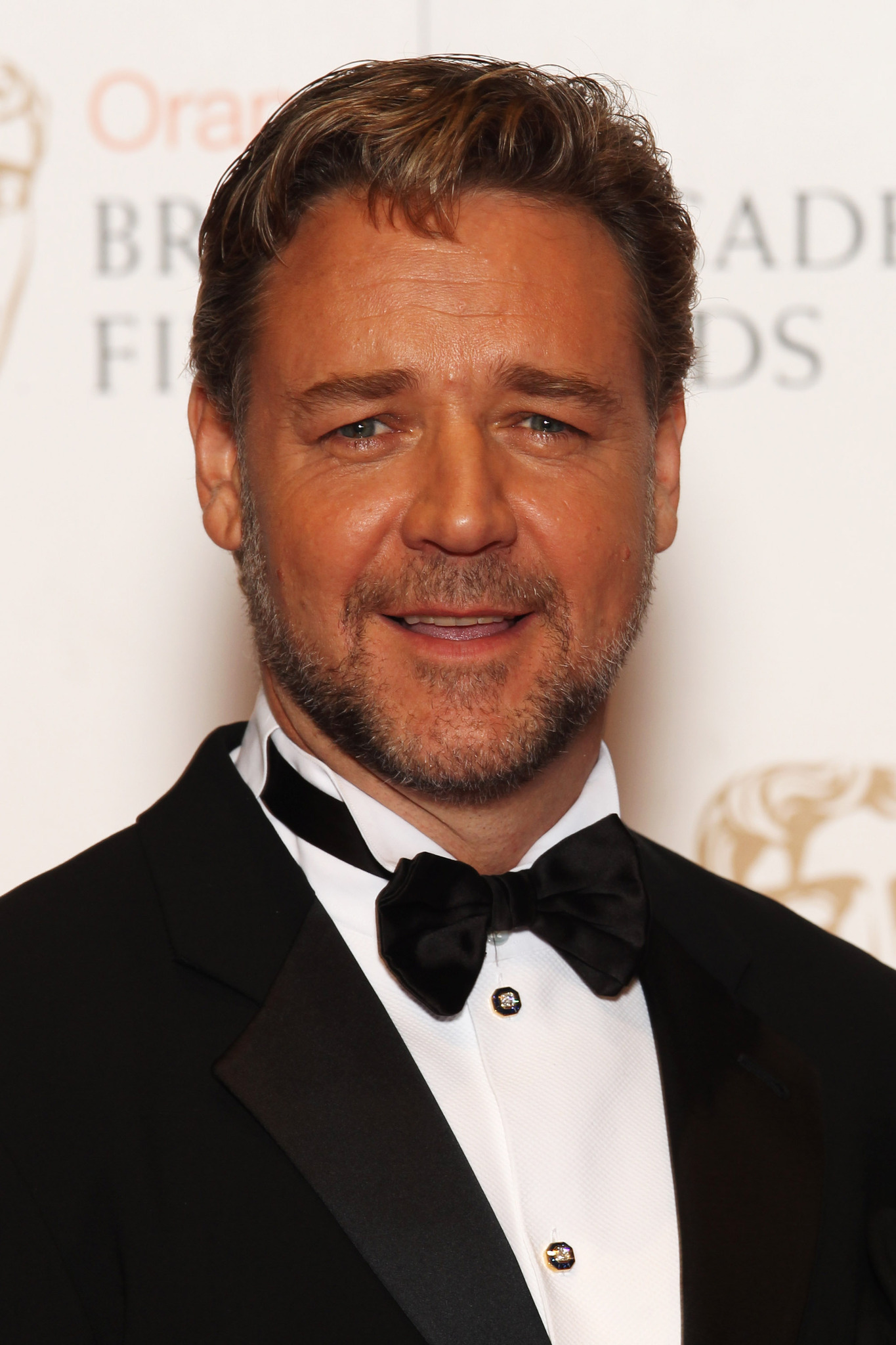
Birth Name
Russell Ira Crowe
Birth Date
1964 April 7
Birth Location
Wellington, New Zealand
Height
182 cm
Professions
IMDb ID
Wikipedia Article
# Russell Crowe
Russell Crowe is a critically acclaimed actor, producer, and filmmaker, known for his powerful performances and versatile roles in a career spanning over three decades. Born on April 7, 1964, in Wellington, New Zealand, Crowe has established himself as one of the leading figures in contemporary cinema. Standing at a height of 182 cm, he has captivated audiences worldwide with his intense portrayals and commanding screen presence. He is particularly notable for his roles in films that explore complex characters and moral dilemmas, which have earned him numerous accolades, including an Academy Award.
Quick Facts: Russell Crowe, born on April 7, 1964, in Wellington, New Zealand, is 182 cm tall. He is an actor, producer, and filmmaker, active since the late 1980s, and is known for his compelling performances in both dramatic and action-oriented roles.
Early Life and Education
Russell Crowe was born into a family deeply rooted in the arts. His father, John Alexander Crowe, was a cinematographer and set designer, while his mother, Jocelyn Yvonne Crowe, was a caterer and a former dancer. Growing up in a creative environment, Crowe was exposed to various forms of artistic expression from a young age. His family relocated to Sydney, Australia, when he was four years old, where he spent the majority of his childhood.
As a child, Crowe was drawn to performance, often participating in school plays and local theater productions. His early experiences on stage sparked a passion for acting that would shape his future career. He attended St. Joseph's College, Hunters Hill, where he developed a strong interest in both drama and sports. Crowe was particularly known for his athleticism, excelling in rugby and swimming, but it was his love for acting that ultimately defined his path. He nurtured his artistic inclinations by engaging in various school and community theater projects, which helped him build confidence and hone his craft.
After completing high school, Crowe pursued acting more seriously, taking on roles in Australian television series and films. His early experiences in the industry provided him a solid foundation, allowing him to develop his skills and gain invaluable insights into the art of storytelling.
Career
Russell Crowe's career began in the late 1980s when he appeared in several Australian television shows, including the popular series "Neighbours." His early roles were characterized by a blend of rugged masculinity and emotional depth, which would become hallmarks of his later performances. Crowe's breakthrough came in 1992 with the film "Romper Stomper," where he portrayed a violent neo-Nazi leader. This role garnered critical acclaim and established him as a formidable talent in the Australian film industry.
Following this success, Crowe's career trajectory soared. He gained international recognition for his performance in "The Insider" (1999), where he played Jeffrey Wigand, a whistleblower in the tobacco industry. This role showcased Crowe's ability to embody complex characters facing moral dilemmas and earned him an Academy Award nomination for Best Actor. However, it was his portrayal of Maximus Decimus Meridius in Ridley Scott's "Gladiator" (2000) that solidified his status as a Hollywood superstar. The film was a box office hit, and Crowe's powerful performance earned him the Academy Award for Best Actor, along with critical acclaim worldwide.
Throughout the early 2000s, Crowe continued to deliver memorable performances in films such as "A Beautiful Mind" (2001), where he portrayed mathematician John Nash, and "Master and Commander: The Far Side of the World" (2003), where he took on the role of Captain Jack Aubrey. His versatility allowed him to navigate various genres, from historical epics to intense dramas, establishing him as one of the most respected actors of his generation.
In addition to acting, Crowe ventured into producing and directing, showcasing his multifaceted talents. He made his directorial debut with "The Water Diviner" (2014), a film set in the aftermath of World War I, which received positive reviews and further demonstrated his commitment to storytelling.
In recent years, Crowe has continued to evolve as an actor, taking on diverse roles in films such as "The Nice Guys" (2016) and "Unhinged" (2020). His willingness to tackle different genres reflects his adaptability and commitment to his craft. Crowe remains an influential figure in the film industry, constantly seeking new challenges and opportunities for artistic expression.
Personal Life
Russell Crowe's personal life has often been in the spotlight, given his status as a public figure. He was previously married to Australian actress Danielle Spencer from 2003 to 2018, with whom he shares two sons. The couple's relationship was characterized by mutual respect and shared interests in music and the arts. Following their separation, Crowe has maintained a positive co-parenting dynamic, emphasizing the importance of family in his life.
Crowe is known for his passionate personality, which has sometimes led to public controversies. Despite this, he is admired for his authenticity and commitment to his principles. Outside of acting, he has a keen interest in music and has released several albums, showcasing his talents as a singer-songwriter. He has also been involved in philanthropic efforts, supporting various charities and causes, particularly those related to health and education.
In his leisure time, Crowe enjoys outdoor activities, including rugby and fishing, which reflect his love for nature and physicality. He is often seen as down-to-earth, with a straightforward demeanor that resonates with fans and colleagues alike. His public image is that of a dedicated artist and a devoted father, who balances the demands of fame with his personal values.
Appearance
Russell Crowe is often recognized for his rugged good looks and charismatic screen presence. His physical appearance has evolved throughout his career, reflecting the diverse roles he has taken on. Crowe's height of 182 cm contributes to his commanding stature, making him a formidable presence on screen.
Over the years, his hairstyle has varied significantly, from short and slicked back in his earlier roles to longer, tousled looks in more recent films. This evolution in style often mirrors the characters he portrays, allowing him to embody different personas convincingly. While Crowe is not heavily tattooed, he has a few tattoos that hold personal significance, further enhancing his tough-guy image.
Filmography Overview
Russell Crowe is known for his diverse filmography, which spans a wide range of genres, including drama, action, and historical epics. His ability to inhabit complex characters has made him a sought-after talent in Hollywood. Crowe's roles often explore themes of redemption, justice, and moral ambiguity, showcasing his depth as an actor. He has worked with some of the industry's most esteemed directors, contributing to a legacy of compelling cinema that resonates with audiences.
Throughout his career, Crowe has collaborated with notable filmmakers such as Ridley Scott, Ron Howard, and Darren Aronofsky, resulting in a body of work that is both critically acclaimed and commercially successful. His performances are characterized by emotional intensity and authenticity, which have garnered him numerous accolades and a devoted fan base.
Awards and Achievements
Russell Crowe's career has been marked by numerous awards and nominations, reflecting his talent and dedication to his craft. He won the Academy Award for Best Actor for his role in "Gladiator," which remains one of the defining performances of his career. In addition to his Oscar win, Crowe has received multiple Golden Globe Awards, BAFTA Awards, and Screen Actors Guild Awards, highlighting his impact on the film industry.
His contributions to cinema extend beyond acting, as he has also been recognized for his work as a producer and director. Crowe's ability to engage audiences through powerful storytelling has solidified his reputation as one of the leading figures in contemporary film.
Legacy
Russell Crowe's influence on cinema and culture is significant. He has redefined the archetype of the leading man, blending vulnerability with strength in his performances. His commitment to portraying complex characters has inspired a generation of actors to embrace multifaceted roles that challenge traditional narratives.
Crowe's enduring appeal lies in his authenticity and dedication to his craft, qualities that resonate with audiences and critics alike. His contribution to film extends beyond individual performances; he has helped elevate the art of storytelling through his work as a producer and director.
As an actor, Crowe has left an indelible mark on the film industry, and his legacy continues to shape the landscape of contemporary cinema. With a career that spans over three decades, Russell Crowe remains a vital and influential figure, celebrated for his artistry and impact on the world of film.
Net Worth
When it comes to estimating the net worth of an actor like Russell Crowe, diving into external celebrity net-worth databases can be a bit like looking at a funhouse mirror. You get a range of figures that can make your head spin. Websites like Celebrity Net Worth, WealthyGorilla, and TheRichest throw around numbers that generally fall somewhere between $70 million to $100 million. The variations usually stem from the methodologies these sites use to estimate wealth, which often involve a mix of reported earnings, property values, and sometimes just plain guesswork. For instance, while Celebrity Net Worth cites Crowe's wealth with a high degree of confidence, other sources might lean on his past film grosses and endorsements to arrive at different figures. The discrepancy can grate on your belief system if you expect accuracy.
These numbers also come with limitations. Most of these sites rely on publicly available information, like earnings from major films or reported salaries, which can sometimes be outdated or incorrect. They often don’t factor in the nuanced aspects of an actor's financial portfolio—stuff like investments, personal business ventures, or the tax implications of high income. So, while they offer a decent starting point, they may not accurately reflect Crowe’s true net worth, which can be far more complex than a simple accumulation of his highest paychecks.
Now, let’s get into the nitty-gritty of estimating an actor's earnings based on their filmography. In Hollywood, supporting actors like Crowe enjoy a unique position, especially when they’ve proven themselves as bankable stars. Salaries vary significantly by decade and can fluctuate based on multiple factors. In the early 2000s, for instance, a supporting star might have earned anywhere from $1 million to $5 million per film, depending on their billing and the film's budget. When a film has a high budget, it typically means more money is in play, which can lead to higher salaries for actors, particularly if they have a strong role.
Billing position also plays a crucial role in negotiation power. Actors who find themselves at the top of the cast list often have the leverage to ask for higher pay—a dream outcome that can significantly inflate their earnings. This is akin to having first dibs at the buffet; the higher your place on the call sheet, the better the options you have.
Television roles can also contribute significantly to an actor’s earnings, with established stars often commanding upwards of $100,000 per episode for major network shows. This can add up quickly if they land a multi-season gig, yielding a significant boost to their overall income.
To provide a clearer picture of Crowe's earnings, I’ve compiled a summary of his major films, their approximate budgets, and my estimated earnings for him in each film:
| Film Title | Approximate Budget | Estimated Earnings for Crowe |
|---|---|---|
| Gladiator | $103 million | $15 million |
| A Beautiful Mind | $58 million | $12 million |
| Master and Commander: The Far Side of the World | $150 million | $20 million |
| Les Misérables | $61 million | $10 million |
| Cinderella Man | $88 million | $15 million |
Diving deeper into these films reveals how I arrived at the estimated earnings for Russell Crowe. Starting with "Gladiator," released in 2000, Crowe had a significant role as Maximus, leading to an estimated paycheck of around $15 million, reflective of both his billing and the movie's massive budget of $103 million. Similarly, for "A Beautiful Mind," which earned him an Academy Award, I approximated his earnings at $12 million, capitalizing on the film's critical acclaim and commercial success.
"Master and Commander: The Far Side of the World" is another standout, with a staggering budget of $150 million, where Crowe’s role as Captain Jack Aubrey likely scored him around $20 million. This reflects the movie's high stakes and Crowe's proven box office draw at the time. In "Les Misérables," his role, while significant, came in at an estimated $10 million, noting that this musical adaptation had a lower budget but still provided him with ample opportunities to shine. Finally, "Cinderella Man" saw him earning about $15 million, a testament to his ability to portray compelling, nuanced characters in high-budget projects.
Crowe has also appeared in various television roles, but those haven’t been as plentiful compared to his film work. If he were to score a major TV deal, he could expect to earn upwards of $100,000 per episode, a number that could quickly add up if he committed to a long-term series. However, the bulk of his earnings comes from his film roles, where he has consistently proven his marketability.
In estimating Crowe's lifetime earnings based on the films discussed, along with his other projects, it’s reasonable to conclude he has likely earned upwards of $100 million throughout his career. This aligns with the upper estimates found on celebrity net-worth websites but somewhat contradicts lower estimates that undersell his filmography's impact. The dissonance between my estimate and external sources may stem from the variables that these databases often overlook, such as the fluctuating nature of earnings, endorsements, and Crowe’s investments.
To synthesize both data sources, I would suggest a realistic net worth range for Russell Crowe to be around $90 million to $120 million. This range accommodates both the high-rollers of the celebrity net-worth websites and the more conservative estimates based on his film earnings. In the end, Crowe’s career is a testament to the complexities involved in evaluating an actor's financial status, demonstrating that while external figures can provide a rough sketch, a deeper analysis reveals the intricate tapestry of an actor's financial life.